


Primary Mathematics
Online Classes
Structured online Maths for ages 5–11 — building number confidence, calculation fluency and strong foundations for life.
About ON22 Academy Primary Mathematics
ON22 Academy is a virtual academy and online education provider offering Primary Mathematics online classes for students aged 5–11. Our support helps children build number confidence, calculation fluency, problem-solving skills and a stronger foundation for Lower Secondary learning. Lessons follow British Curriculum expectations where suitable and are delivered through structured online teaching, guided practice and parent feedback.

Building Mathematical Confidence Early
Primary Mathematics is one of the most important foundations in a child’s education. When children feel confident with number, calculation and problem solving, they usually approach later learning with more independence. When early gaps are missed, Mathematics can quickly become stressful.
A child may begin by struggling with times tables, place value or fractions — but later those gaps can affect algebra, ratio, percentages and GCSE preparation. ON22 Academy’s primary mathematics online classes help children understand mathematics clearly, practise regularly and rebuild confidence where it has been lost. The aim is not to rush children ahead before they are ready. The aim is to make sure the foundations are secure enough for the next stage.
Who Primary Mathematics Support Is For
Primary Mathematics support may be suitable for children who:
Ages 5–11
Support tailored to the child's age, confidence and current level.
British Curriculum Maths
Lessons aligned to British Curriculum expectations where suitable.
Confidence Gaps
Children who lack confidence with number, times tables, or fractions.
Home Educators
Structured Maths teaching for families who home educate.
International Students
UK-style Maths support for families learning abroad.
Additional Challenge
Students who need enrichment beyond standard classwork.
Disrupted Learning
Gaps from school moves, curriculum changes or missed lessons.
Lower Secondary Prep
Preparing for the transition into secondary Maths.
Guided Practice
Students who benefit from patient explanation and regular support.
Why Primary Maths Gaps Matter
Primary Maths gaps often look small at first. A child may be able to complete simple sums but struggle when numbers are presented differently. They may know a times table chant but not understand multiplication.
These gaps matter because later Mathematics builds on earlier understanding:
- Weak place value can affect written calculations.
- Poor times table recall can slow down fractions and division.
- Weak fraction understanding affects percentages and ratio.
- Poor problem-solving habits affect exam-style questions later.
- Low confidence can cause children to avoid Mathematics altogether.
This is why Primary Mathematics should not be treated as easy Maths. It is the foundation of everything that follows.

What Students May Learn
Topics covered depend on the child’s age, confidence and current level.
🔢 Number & Place Value
Counting, number patterns, place value, comparing and ordering numbers, rounding, negative numbers, reading and writing larger numbers, digit value.
➕ Addition, Subtraction, Multiplication & Division
Mental arithmetic, written methods, number bonds, times tables, division facts, multiplication strategies, checking answers, choosing the right operation, multi-step calculations.
🔣 Fractions, Decimals & Percentages
Recognising fractions, equivalent fractions, comparing fractions, adding and subtracting fractions, fractions of amounts, decimal place value, converting simple fractions and decimals, early percentage understanding.
📐 Shape, Space & Measure
2D and 3D shapes, symmetry, angles, perimeter, area, volume, time, money, length, mass, capacity, units of measure, reading scales.
📊 Statistics & Data
Tables, charts, bar graphs, line graphs, pictograms, interpreting information, comparing data, simple averages where appropriate.
🧩 Reasoning & Problem Solving
Word problems, multi-step questions, explaining methods, spotting patterns, checking whether answers make sense, choosing the right strategy, using mathematical vocabulary, building resilience.
How Primary Maths Lessons Work Online
Primary students need clear, structured and age-appropriate lessons. ON22 Academy’s online classes are designed around a consistent structure:
- Teacher-led explanation — Concepts explained step by step with clear examples.
- Guided practice — Students practise with support before working independently.
- Questioning and discussion — Understanding checked through questions and responses.
- Visual support — Diagrams, virtual whiteboards and worked examples as needed.
- Follow-up practice — Short activities to strengthen recall and confidence.
- Parent feedback — Updates on progress, effort and areas needing more practice.
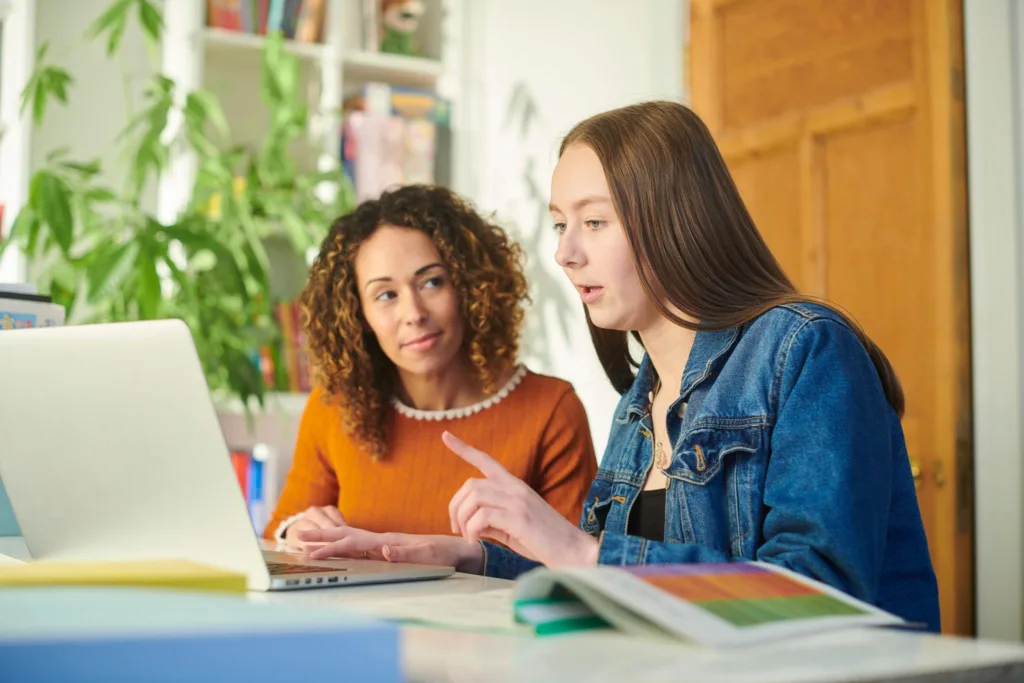
Primary students should not be left to manage everything alone. Parent support at home remains important, especially for attendance, concentration and follow-up work.
Confidence Comes Before Speed
Understand the method
Not just copying steps — genuinely grasping why it works.
Practise accurately
Building fluency through regular, focused repetition.
Explain thinking
Narrating reasoning builds deeper understanding.
Build recall gradually
Retention grows through spaced, repeated practice.
Spot mistakes
Learning to catch and correct errors independently.
Try again without panic
Building resilience so setbacks don't become barriers.
For some students, the first sign of progress is not a higher score — it is a calmer attitude towards Maths.

Our Experience Supporting Primary Maths Families
Supporting Home-Educated Students
- How often Maths is practised each week
- Whether key topics are being covered in sequence
- Whether the child is retaining previous learning
- How confidence is developing over time
- Whether the child is ready for Lower Secondary Mathematics
- Whether there is enough problem solving, not just calculation practice
Parents and guardians remain responsible for checking official home education, local authority, safeguarding, legal and educational requirements that apply to their child.
Supporting International Students
International families may choose Primary Mathematics online classes because they want their child to follow British Curriculum expectations while living outside the UK. This may help students who:
- Move between countries
- May return to UK education later
- Need English-medium Mathematics support
- Are studying a different curriculum but need British alignment
- Need flexible online learning across time zones
- Want a stronger foundation before Lower Secondary study
Preparing for Lower Secondary Mathematics
Secure place value
Reliable arithmetic
Times table confidence
Fraction understanding
Decimal & percentage foundations
Measurement skills
Problem-solving habits
Mathematical vocabulary
A student does not need to be perfect before moving forward — but they should have enough foundation to cope with more abstract ideas such as algebra, ratio, graphs and multi-step reasoning.
This Support May Suit Your Child If…
- Needs stronger number confidence
- Avoids Maths or becomes anxious around it
- Has gaps in times tables, fractions or written methods
- Needs British Curriculum Mathematics support
- Is home educated and needs a structured Maths routine
- Is learning internationally and needs UK-style support
- Needs preparation before Lower Secondary
- Benefits from clear explanation and regular practice
- Can engage with online lessons with suitable home support
This Support May Not Be Right If…
- The child cannot focus online even with adult help
- There is no quiet learning space at home
- Attendance is likely to be irregular
- Parents expect the teacher to manage all practice remotely
- The child needs full-time in-person supervision
- Follow-up work will not be completed
- The family wants only occasional homework answers rather than structured learning
This does not mean the child cannot be helped — it means the support may need to be adjusted or the home routine strengthened first.
What Parents Can Do at Home
Parents do not need to be Maths experts, but they can make a big difference.
- Practise times tables regularly together
- Encourage your child to explain their thinking
- Keep a calm tone when mistakes happen
- Check that follow-up work is completed
- Use everyday Maths — time, money, cooking, measuring
- Review teacher feedback regularly
- Avoid negative labels such as ‘not a Maths person’
- Protect lesson time from distractions
- Celebrate steady improvement, not just correct answers
- Remember: small, regular practice beats occasional long sessions
Start with a Primary Mathematics Consultation
A consultation helps us understand your child’s current level before recommending support. We will discuss your child’s age, confidence, key gaps, and whether online learning is a good fit. Topics we usually cover: age & school situation · confidence with Maths · times tables & number fluency · fractions, decimals & problem solving · available home support · consolidation, confidence or challenge needed
 Achieve Academic Excellence with Expert Mathematics, Science, and English Academy Worldwide