


Lower Secondary Science
Online Classes
Structured online Science for ages 11–14 — building Biology, Chemistry and Physics foundations, scientific vocabulary and GCSE readiness before exam pressure begins.
About ON22 Academy Lower Secondary Science
ON22 Academy is a virtual academy and online education provider offering Lower Secondary Science online classes for students aged 11–14. Our support helps students build knowledge in Biology, Chemistry and Physics while developing scientific vocabulary, enquiry skills, evidence-based reasoning and confidence before GCSE or IGCSE Science preparation begins. Lessons follow British Curriculum expectations where suitable and are delivered through structured online teaching, guided discussion, visual explanation and parent feedback.

Building the Bridge Between Primary Science and GCSE
Lower Secondary Science is the stage where students move from early curiosity into more structured scientific understanding.
At Primary level, Science often begins with observation, simple enquiry and everyday examples. At Lower Secondary level, students begin to use more technical vocabulary, explain processes in greater detail and understand how Biology, Chemistry and Physics connect to the world around them.
This is also the stage where hidden gaps can appear. A student may enjoy Science but struggle to explain answers clearly. Another may know facts but find it difficult to use evidence, read graphs or understand scientific vocabulary.
ON22 Academy’s Lower Secondary Science online classes help students build the subject knowledge and enquiry skills they need before GCSE or IGCSE Science becomes more demanding.
The aim is not to rush students into exam papers too early. The aim is to make sure they understand the science properly before examination pressure begins.
Who Lower Secondary Science Support Is For
Lower Secondary Science support may be suitable for students who:
Ages 11–14
Support tailored to the student's current level across all three sciences.
British Curriculum Science
Lessons aligned to British Curriculum expectations where suitable.
Biology, Chemistry or Physics
Students confident in one science but weaker in another.
Home Educators
Structured Science teaching across all three disciplines for home ed families.
International Students
English-medium Science support with British Curriculum alignment.
Scientific Vocabulary
Students who struggle to use scientific terms precisely in explanations.
GCSE Preparation
Building readiness before Combined Science or separate sciences begins.
Data & Graph Confidence
Students who need help interpreting evidence, graphs and tables.
Moved Between Systems
Students with gaps from changing schools, countries or curricula.
Some students need support across all three sciences. Others may be confident in Biology but weaker in Physics, or enjoy Chemistry but struggle with calculations. A consultation identifies the right approach.
Why Lower Secondary Science Matters
Lower Secondary Science prepares students for the way Science is studied later. GCSE and IGCSE Science are not only about remembering facts — students need to explain processes, apply knowledge, interpret results and answer questions precisely. Lower Secondary is where those habits should begin.
Scientific explanation
Moving from describing what happens to explaining why it happens.
Evidence-based reasoning
Using evidence to support conclusions rather than guessing.
Data interpretation
Reading graphs, tables and results with confidence and accuracy.
Technical vocabulary
Using subject-specific words correctly in written and spoken Science.
Experimental method
Planning investigations, identifying variables and understanding fair testing.
Cause and effect
Understanding why one change leads to another in biological, chemical or physical systems.
Applying knowledge
Transferring understanding to unfamiliar questions and new contexts.
Writing clear scientific answers
Structuring explanations precisely rather than in vague everyday language.
Understanding models
Using particle models, diagrams and systems to explain abstract ideas.
What Students May Learn
Topics covered across Biology, Chemistry and Physics depend on the student’s age, confidence and current Science level.
🌿 Biology
Cells and microscopes, tissues, organs and organ systems, the human body, digestion, respiration, circulation, plants and photosynthesis, ecosystems, food chains, adaptation, variation and inheritance, health and disease, environmental change. Students move from everyday language into accurate scientific explanation.
⚗️ Chemistry
Solids, liquids and gases, particle models, atoms, elements and compounds, mixtures and separation, acids and alkalis, chemical reactions, metals and non-metals, the periodic table (introductory), materials, combustion, environmental chemistry and safety. Chemistry vocabulary must be used precisely.
⚡ Physics
Forces, motion, speed, gravity, pressure, energy stores and transfers, electricity and circuits, magnetism, light, sound, waves, heat transfer, space physics (introductory), graphs and simple calculations, scientific models. Physics builds confidence connecting scientific ideas to everyday examples before GCSE calculations become more technical.
🔬 Scientific Investigation & Enquiry
Asking scientific questions, making predictions, identifying variables, fair testing, planning investigations, recording observations, reading tables and graphs, analysing evidence, drawing conclusions, evaluating methods. Students need to understand that Science is a way of testing ideas — not only a list of facts.
🎯 Adapted to Each Student
Topics depend on the student’s age, confidence and current level. Some need consolidation across all three sciences. Others need to strengthen one specific area or extend their thinking before GCSE choices. A consultation identifies the right starting point.
Scientific Vocabulary Matters
Science has a large vocabulary, and this can become a barrier for students. A student may understand a topic in everyday language but lose marks or confidence because they cannot express the idea accurately in scientific terms.
Good Lower Secondary Science teaching should help students use scientific words clearly, without making the subject feel unnecessarily complicated.
Students need repeated exposure and practice — not just memorising a list once before a test.
Key scientific terms students may practise:

Science, Maths and English Work Together
Science depends on more than scientific facts. Students also need Mathematics and English skills. This is why some students struggle with Science even when they enjoy the subject — the difficulty may not be the idea itself, but the way the answer must be explained, calculated or presented.
Read questions carefully
Understanding command words and exactly what is being asked.
Interpret a graph
Extracting meaning from data tables, scatter graphs and line graphs.
Calculate accurately
Speed, density, percentage change — with correct units.
Write clear explanations
Structuring scientific answers using the right vocabulary.
Compare evidence
Identifying patterns and evaluating what results show.
Structure longer answers
Organising multi-point explanations logically and precisely.
How Lower Secondary Science Lessons Work Online
Lower Secondary Science lessons need to be clear, visual and interactive. ON22 Academy’s online classes combine explanation, discussion and enquiry so students develop both knowledge and scientific thinking:
- Teacher-led explanation — Scientific concepts taught through clear explanation and worked examples.
- Guided discussion — Teachers use questions to check understanding and encourage students to explain ideas in their own words.
- Visual learning — Diagrams, models, images and virtual whiteboards help students understand abstract scientific ideas.
- Scientific vocabulary practice — Students practise using subject terms accurately in both spoken and written explanations.
- Data and enquiry tasks — Students work with tables, graphs, evidence and investigation-style questions.
- Feedback and correction — Students receive feedback on understanding, written explanations and scientific reasoning.
- Parent communication — Updates on progress, effort and areas needing more practice at home.
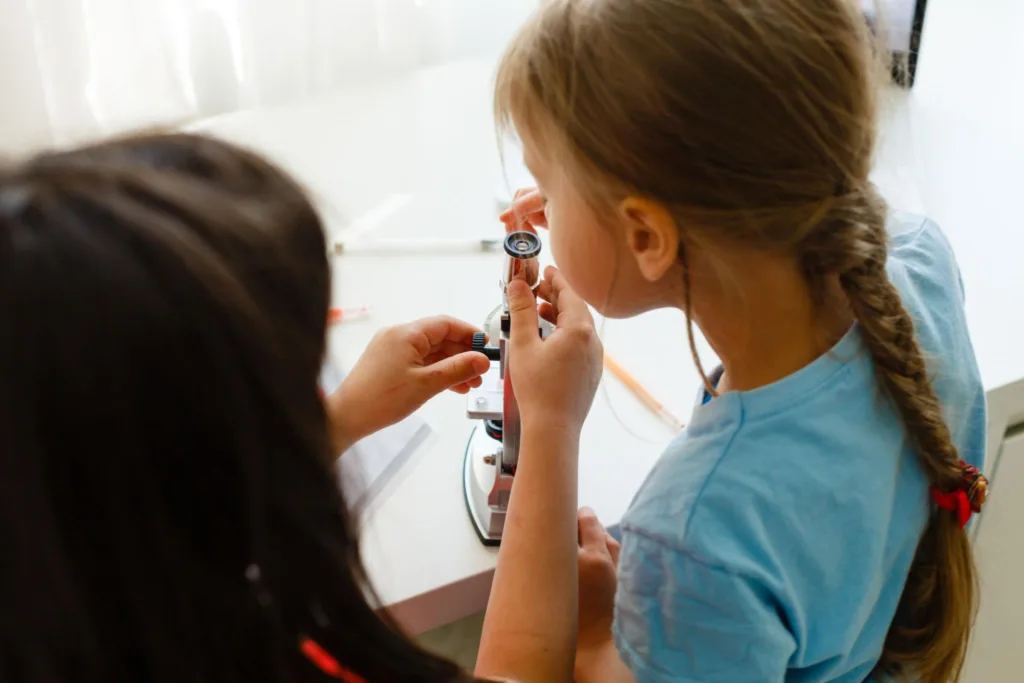
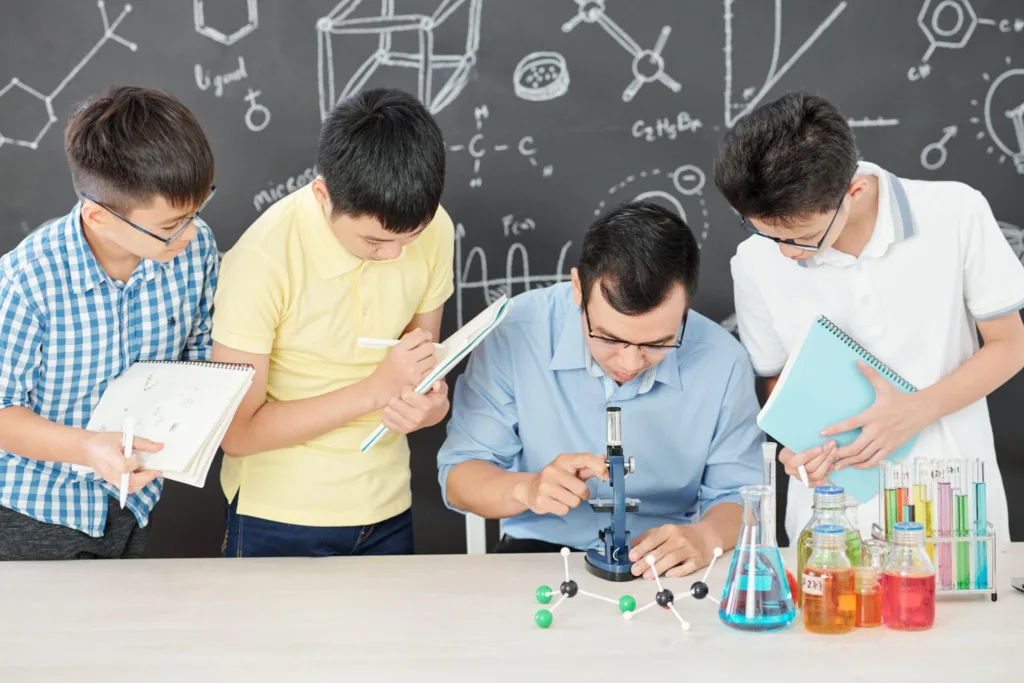
Practical Science and Online Learning
Science includes practical enquiry, and families should understand how this works in an online context. Online lessons can support:
- Scientific explanation and diagrams
- Data interpretation and graph reading
- Investigation planning
- Evaluating results and methods
- Understanding variables and fair testing
- Safety awareness
- GCSE and IGCSE practical knowledge
The Real Challenge at Ages 11–14
Students aged 11–14 often enjoy Science but do not always realise how much the subject changes. These challenges can be improved with structured teaching and regular practice. Lower Secondary Science should help students become more precise — learning not only what happens, but why it happens and how scientists know.
Knowing facts but not explaining them
Students can recall information but cannot structure a clear scientific answer.
Avoiding Physics calculations
Mathematics in Science causes anxiety even when the concept is understood.
Finding Chemistry too abstract
Particle models and reactions feel disconnected from everyday experience.
Misreading graphs
Students extract wrong values or miss patterns in data and results.
Forgetting units
Answers lose marks because m/s, joules, volts or kg are omitted.
Relying on memory without understanding
Students memorise answers without being able to apply knowledge elsewhere.
Our Experience Supporting Lower Secondary Science Families
In our experience, many students enjoy Science until the explanations become more technical.
A student may love space, animals or experiments, but still struggle when asked to write a six-mark explanation, interpret a graph or use words such as diffusion, compound, resistance or variable correctly.
Parents often notice that their child is interested in Science but underperforms in assessments. That usually means the student needs help turning interest into structured scientific understanding.
The strongest progress happens when students attend regularly, practise explaining ideas and learn from feedback rather than simply memorising notes. A student who builds confidence at Lower Secondary is better placed when GCSE Science choices arrive.
Preparing for GCSE and IGCSE Science
Lower Secondary Science should prepare students for future GCSE or IGCSE study without turning every lesson into exam training. Students who enter GCSE with weak foundations often find the workload difficult — learning new content while repairing earlier gaps. Lower Secondary is the right time to strengthen those foundations.
Biology foundations
Chemistry foundations
Physics foundations
Scientific vocabulary
Data interpretation
Graph reading
Practical enquiry
Evidence-based conclusions
Scientific calculations
Written explanations
Revision habits
Applying knowledge to new questions
Combined Science or Separate Sciences Later?
At Lower Secondary level, most students do not need to make a final decision about Combined Science or separate Biology, Chemistry and Physics yet. However, their progress at this stage can affect future options.
Combined Science may suit many students because it provides a broad route through all three sciences. Separate sciences may suit students with strong Science interest, future STEM ambitions or plans involving Medicine, Engineering, Veterinary Science, Pharmacy or Biomedical Science.
The decision later should consider:
- Current Science confidence
- Strength across Biology, Chemistry and Physics
- Mathematical confidence
- Workload and timetable
- Future A Level plans
- Exam board and centre availability
- Private candidate options where relevant
- Student motivation and independence
Lower Secondary Science helps families make that decision with better evidence later.
Supporting Home-Educated Students
Lower Secondary Science is especially important for home-educated students because it prepares the ground for future GCSE or IGCSE decisions.
ON22 Academy can support home-educating families with structured Science teaching, guided enquiry and parent communication.
Home-educating parents may need to think about:
- Whether Biology, Chemistry and Physics are all being covered
- Whether Science is studied regularly
- Whether the student can explain scientific ideas clearly
- Whether practical enquiry is included safely
- Whether scientific vocabulary is developing
- Whether future GCSE or IGCSE Science routes may be needed
- Whether private candidate exam planning may eventually apply
Parents and guardians remain responsible for checking official home education, local authority, safeguarding, legal and examination requirements that apply to their child.


Supporting International Students
International families may choose Lower Secondary Science online classes because they want their child to follow British Curriculum expectations while living outside the UK.
- Moving between countries
- May enter UK education later
- Need English-medium Science support
- Studying in another curriculum but need British Curriculum alignment
- Preparing for future GCSE or IGCSE Science
- Need stronger scientific vocabulary in English
- Need flexible online learning across time zones
International students may have covered similar topics in a different order or with different practical expectations, creating hidden gaps. Families should consider time zones, English confidence, curriculum background and future examination plans.
This Support May Suit Your Child If…
- Is aged 11–14
- Enjoys Science but needs more structure
- Needs stronger confidence in Biology, Chemistry or Physics
- Struggles with scientific vocabulary
- Finds scientific explanations difficult to write
- Needs help with graphs, data or evidence
- Needs British Curriculum Science support
- Is home educated and needs structured Science teaching
- Is learning internationally and needs English-medium Science support
- Needs preparation before GCSE or IGCSE Science
- Can attend online lessons consistently
This Support May Not Be Right If…
- The student is already preparing for final GCSE or IGCSE Science exams and needs Upper Secondary support
- The student cannot focus online even with support
- Attendance is likely to be irregular
- Follow-up tasks will not be completed at home
- There is no suitable study space
- Parents expect online lessons to replace all practical enquiry
- The student needs full-time in-person supervision
- The family wants only occasional homework answers rather than structured learning
This does not mean the student cannot improve — it means the pathway may need to be adjusted or the home routine strengthened first.
What Parents Can Do at Home
Parents do not need to be Science specialists, but they can help create the conditions for progress. Science learning grows through explanation, practice and curiosity — students need space to ask questions and enough structure to answer them properly.
- Encourage scientific questions
- Ask the student to explain ideas clearly
- Review teacher feedback together
- Help the student keep notes organised
- Encourage regular revision of key vocabulary
- Support safe observation tasks where suitable
- Connect Science to everyday examples
- Check that follow-up work is completed
- Encourage accuracy with units and diagrams
- Do not wait until GCSE to address gaps
Start with a Lower Secondary Science Consultation
A consultation helps us understand your child’s current Science level before recommending support. We will discuss age, school situation, confidence across Biology, Chemistry and Physics, scientific vocabulary, written explanations, data and graph confidence and whether online learning is suitable.
Topics we usually cover: age & situation · Biology, Chemistry & Physics confidence · scientific vocabulary · written explanations · data & graphs · practical enquiry · GCSE Science plans · home support available · consolidation, confidence or challenge needed
 Achieve Academic Excellence with Expert Mathematics, Science, and English Academy Worldwide